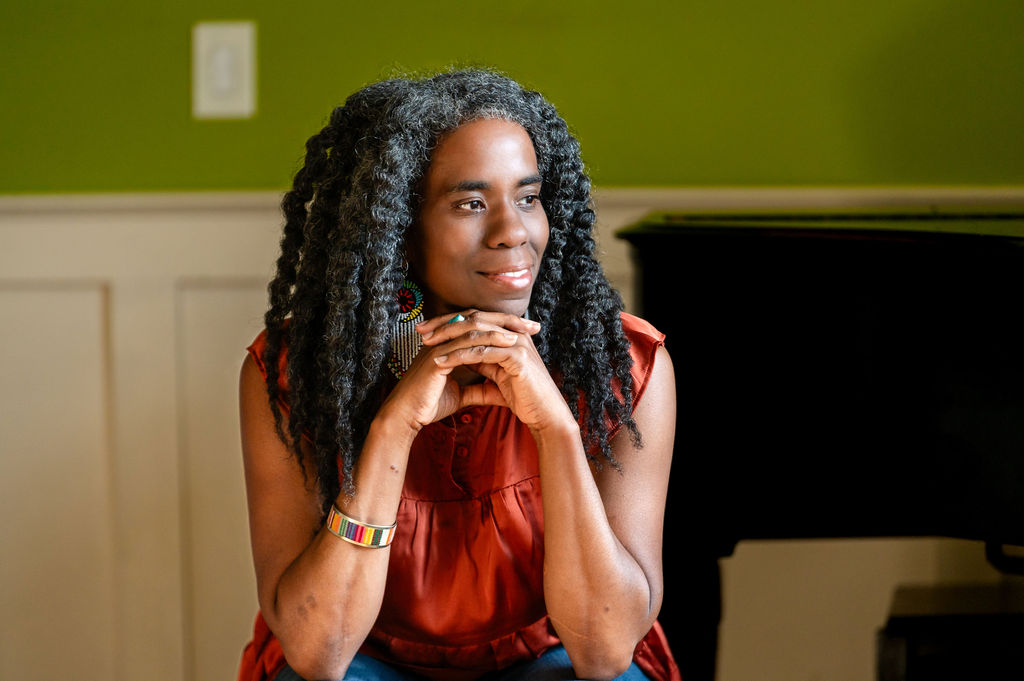
Before Alyscia Cunningham loved filmmaking, she loved to draw. Before she loved documentaries, she loved photography and portraiture. Before she loved crafting horror shorts, she loved listening to her father tell scary stories, both real and imagined, about what life was like in his day.
Our roots help make us who we are, though it’s not always easy to trace them in a straight line. We grow in tangles of different life stages – a web of the stories, interests, and people that shape us. Forgetting where we’ve come from is forgetting who we are. Some stories and traditions underrepresented in modern media are even slowly being forgotten.
Documentary filmmaking and the horror genre don’t have much in common on the surface – but crossing creative boundaries is writer/director Alyscia Cunningham’s specialty. As an artist who works in multiple mediums, her path into production has been less than conventional. As it is now, all roads seem to lead back to her roots: the stories she heard from her Trinidadian parents as a child growing up in Queens, New York.
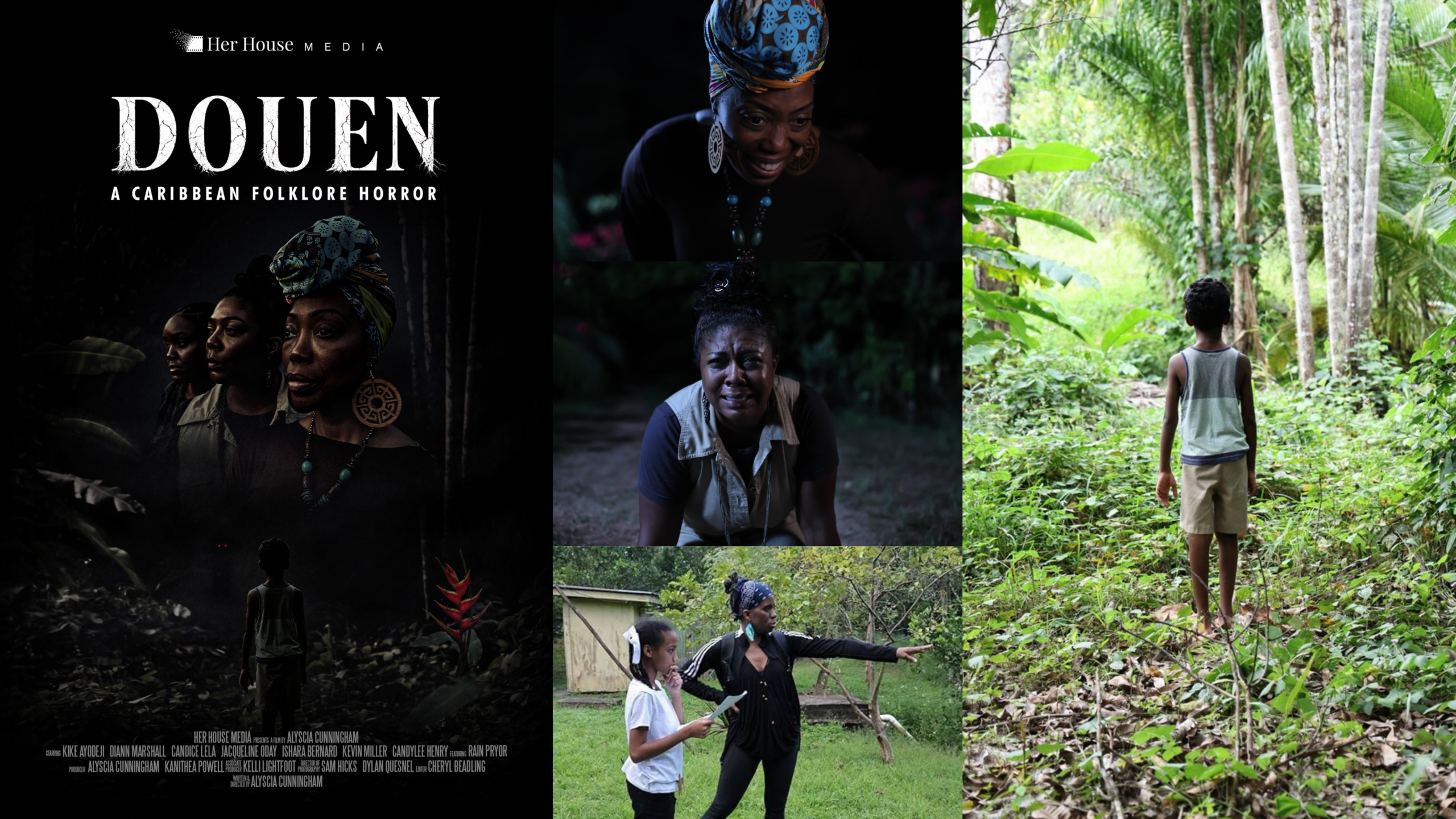
Cunningham’s most recent project is DOUEN, her first feature-length horror film named for the haunting entities of Trinidad and Tobago folklore. Its screening is scheduled for November 1st at the AFI Silver Theater. The logline is “Sania must confront her family’s dark past and generational trauma when she becomes haunted by supernatural Caribbean entities who force her to face her grandmother’s vengeful curse.”
But how do you trace the shift from portrait photography to folklore horror?
“Why Are You Not a Filmmaker?”
While Cunningham grew up experiencing the arts and storytelling through her family, she hadn’t initially planned to work in film. Her earliest public art works came in the form of published photography books, Feminine Transitions and I Am More Than My Hair, which were produced during independent study courses at Montgomery College. Cunningham started school undecided about her major, but always created art throughout her courses.
“I’m still not sure what made my professor from my drawing class connect the dots,” Cunningham said, “but he said to me… ‘I think you should try photography.’ And I fell in love with photography. What I learned from my first book was it’s really, really important to capture footage, even if you’re doing photography, when you’re raising money. So, I started capturing footage as I was meeting these women in I Am More Than My Hair… giving a little backstory.”
What had first been imagined as fundraising footage turned into Cunningham’s first documentary. After connecting with Women in Film & Video (WIFV) member Bonnie Rich at a networking event, she learned the Docs in Progress Trailer Night program (co-hosted by WIFV) creates avenues for documentarians to receive feedback on their film’s early promotional materials. Seeking input on her footage, Cunningham submitted her fundraising materials to Trailer Night. The response and support she received launched a new stage of her multimedia career.
“I remember in the audience that everyone seemed pretty captivated,” Cunningham recalled. “This one gentleman said, ‘Why are you not a filmmaker?’ I was like, ‘No, no, no… this is just footage that I need for my Kickstarter campaign.’ And he said, ‘No, you are a filmmaker. This should be a film.’ So, from there, honestly, I jumped into it.”
Cunningham set to work collecting the full stories of the women featured in her photography collection and transformed I Am More Than My Hair into her first award-winning short film in 2019. She continued to connect with local creators both through WIFV and Women of Color Filmmakers (WOCF). WOCF’s virtual narrative film lab gave her the tools she needed to expand beyond documentary into fiction.
Documentary, Horror, and Empathy
Horror has held a special interest for Cunningham since childhood. Growing up with a family from Trinidad and Tobago meant being surrounded by true stories and folklore that captured the challenges faced by her mother, father, and elders. Cunningham found unexpected similarities in how both documentary and horror position audiences directly inside someone’s story. With empathy as the two genres’ common denominator, her transition into horror came naturally. Cunningham looked to her childhood for inspiration on her second fiction film, choosing “…one of the stories that scared me so good, I wrote about it.”
“The folklore of the douen is said to be children who died when they were really young… prior to being baptized,” Cunningham explained. “They had backwards-facing feet, so that you can’t trace their tracks. They’re said to have no face except for a mouth. The saying goes, they replicate the voice of a loved one, so you don’t respond if you hear somebody call your name.”
At the age of four and five, that visual was frightening enough to stick with her. With hindsight, Cunningham saw the practical value of the story for teaching young children – lessons in stranger danger, for instance – but dug deeper into the folklore to write a script about a family confronting their dark past.
“I made the folklore the trigger to the generational trauma that’s happening in the family,” she said. “It’s also about… healing from that trauma when there is no apology from our elders. So, I want people to be able to walk away from seeing this film and say… ‘Maybe Grandma had a story that was challenging, which makes her the way she is…’ I want them to, when they go home, be able to… just sit down with their elders and ask a question like, ‘What was it like growing up?’ I think that learning about who your elders are… can give a lot of insight to who you are. I want [the film] to be a conversation piece, more than anything.”
Cunningham describes herself as “an impact artist,” with the underlying goal of inspiring change, understanding, and empathy through her work. To accomplish that, she imbued DOUEN with bits and pieces of her own family’s story and prioritized authentic Caribbean voices during production.
An “Unconventional” Production
A film so deeply tied to Trinidad and Tobago demanded to be shot on location for its pivotal sequences. The realities of making that happen on a budget presented a unique set of challenges – not the least of which was casting for local talent.
To ensure the authenticity of the Caribbean cultures represented, Cunningham collaborated with the Trinidad and Tobago Performing Arts Network to cast local talent, particularly for child actors’ roles. However, she found limited information on children based in south Trinidad, where she would be filming. She began recruiting talent through “unconventional” means, expanding beyond traditional casting networks. For some key roles, this meant discovering actors through friends of friends, or through support from her Trinidadian cousin. Baltimore-based casting director Kimia Workman worked with Cunningham to fill out the remaining roles in the U.S.
By reaching out directly to local communities, Cunningham’s “No fake accents” rule became an avenue for spotlighting talent with less access to opportunities in film. For all the children cast, this became their first experience on set.
“It took me a lot more time, to be honest, to be able to find authentic representation of actors, but it was worth it,” Cunningham said. “I think representation is important. There’s certain nuances… that somebody who’s not of [Caribbean] culture would not relate to.”
After screening her proof-of-concept short (DOUEN II) in 2025, Cunningham assembled a skeleton crew from Trinidad and Tobago for the feature. She began gathering her team in February of 2026, during her time in Trinidad for Carnival. The crew’s remote location in the dense, south Trinidad bush of Palo Seco was scouted by Cunningham’s cousin.
Cunningham described the natural landscape as “breathtakingly beautiful,” immediately bringing the space she’d imagined to life. Her favorite memories of the project were formed there, in the bush. However, limitations on the production’s time and budget quickly shrank their available resources.
“What I had imagined would be 21 days of filming [in both the USA and Trinidad and Tobago], we had to do in nine days,” Cunningham said. “There’s some things we just could not capture, because we just didn’t have the time. Seeking funding… never really ends. There’s some things I could not do or implement [for the feature-length version of DOUEN]… but now it’s funding for distribution and marketing.”
Other natural obstacles, like the island heat, reworking scenes at the last minute, or even pervasive on-set chatter demanded the production team’s problem-solving creativity. In the end, however, Cunningham said she was glad she didn’t hesitate to dive headfirst into the project.
“If I would’ve been waiting for the funding,” she said, “I would’ve never gotten it done.”
From Production to Community Screening
Two years of hard work bringing Trinidad and Tobago folklore to life has culminated in a DC-based event, the DOUEN Community Screening. The feature-length rendition of DOUEN will play at the AFI Silver Theater and Cultural Center on November 1.
The event is designed as a celebration of Caribbean folklore, featuring a pre-screening cultural performance with steelpannists and dancers. Many sponsors and community partners have rallied behind the film’s launch, contributing photography services, catered Caribbean-inspired cuisine, and promotional efforts to create a memorable premiere night.
After the credits roll, guests will share in a live audience Q/A with Cunningham and the cast, moderated by UMD College Park professor Cécile Accilien. President of the Trinidad and Tobago Association of DC, Claudia Avril Carter, will MC for the evening. This WIFV-sponsored screening is open to the public, though VIP tickets with a private reception and Virtual Reality experience have already sold out.
Cunningham, ever fundraising for the film, hopes to eventually give DOUEN a limited run in the film festival circuit and an independent theatrical release. The local south Trinidad community where DOUEN was shot is excited for the film’s completion, eagerly anticipating its distribution. Cunningham is working to secure a Caribbean-based premiere, though screening details have yet to be announced. At the end of it all, her hope is that her work creates awareness for underrepresented cultures and preserves a long oral storytelling tradition through film.
“I think people are not aware that the Caribbean is much bigger than Jamaica,” Cunningham said. “There’s actually over 7,000 Caribbean islands, big and small. And also, I want people to be aware of… specifically the Trinidad and Tobagonians, because these folklore stories are fading… The elders have died with these stories, so it’s like waking the story back up.”
Cunningham’s latest work bridges a gap between oral and visual storytelling, folklore traditions and modern life. Her desire to create for a variety of mediums, film genres, and cultures has resulted in a project where generations of storytelling traditions intersect. DOUEN is a tangle of cultural and familial roots, woven together to create an impact. WIFV is proud to take part in supporting the film’s launch.
More information about Alyscia’s projects can be found on her website, alyscia.com, or through her IMDB page. If you’re interested in attending DOUEN’s premiere on November 1, you can sign up using this link.
Don’t forget to check our blog regularly for more deep dives into WIFV members’ work! If you or a filmmaker you know in the WIFV network would like to participate in the Member Spotlight series, feel free to submit a request to Ashley Worley, WIFV Intern, at alworleymedia@proton.me.