Post pandemic, exhausted from overwork as climate change advocate for a DC based charity and health crises that led to the sale of a family home, I was heading for burn out. A major life change beckoned, but I was not sure what it was. In my 20s, I researched film schools. Conditions back then didn’t allow me to pursue it, but I could never quite silence that voice in my head. Needing to get it out of my system, I applied to Prague Film School. Being admitted was a major shock. This would require leaving my job, flying to an unknown place to join a group of students, all probably far younger than I. Doubts surged, but, when I asked a friend for advice, he encouraged me. And so, 30 years after my first attempts failed, I set off to make films.
What followed was a plethora of surprises. First, I was not the only senior student in my year, nor was I the oldest woman to ever graduate from it. Then, the city of Prague delivered more than I expected. Who knew that so many movies had been filmed in this beautiful, historic, well preserved city?
Neither had I anticipated studying all aspects of filmmaking. I had applied to the directing program, but the PFS approach covers everything – from idea to screen: writing, concept development, pitching to the faculty, production documents for the greenlight to shoot, set design and art, lighting, sound recording and mixing, equipment selection and use; selection of cast and crew. PFS workshops rotate every role on set, so I also had a go hands on at everything, including gaffing and camera. Unexpectedly, I was cast in my colleagues’ films. Being the only senior female student in my year had its advantages after all!
Then, there were the electives. I studied the French, Italian and Czech New Wave, masterpieces of world cinema, Iranian films, aspects of film language, powerful directing techniques, directing actors, Ingmar Bergman techniques, sound design and production. In year two, we studied the relationship between cinematographers and directors. A lover of film since the age of 15, doing all of this was like entering heaven.
It was also hard work. We made 1 min, 2 mins, 3 mins, 5 mins, and 10 minute films in Year 1 and in year 2, a fascinating mood reel project leading up to our final diploma film – a short of 30 minutes max. It wasn’t all stress free. Editing was hard; I was the slowest student in the class. Being born before the digital age clearly did not help. I handled heavy, expensive film equipment with trepidation. Twice, I got derisive comments from younger male colleagues on set, as did others.
But by far the biggest surprise was in myself. Non-profit work experience, it turned out, had prepared me to be a good producer, while non profit values proved useful at a time when the film industry, after Me Too, was grappling with ways to work more respectfully on set. Moreover, my life had given me stories worth telling. I discovered a deep love for working with actors and for the creative, collaborative process of filmmaking. I made new friends with people who loved, and lived, cinema as much as I did. I found my tribe.
I now work part time as a producer/assistant director, and just got paid for two minutes in a feature film where I played a college professor who suddenly drops dead after her school is hit by a mystery scourge. Working full time in film still feels like a distant goal at times, but, meanwhile, I have teamed up with a PFS colleague to promote green principles in filmmaking, which combines my previous work experience with current skills. Work is progressing on a pitch to production companies for a feature film and documentary.
Upon graduation in 2023, friends congratulated me for ‘following my dreams’, but this vocabulary belies the process – its ups and down and moments in between. It would be far more accurate to say that film school unlocked creativity far too long suppressed by my own dogged pragmatism, and that creativity, in turn, re-energized me. After years of saying No to expressing myself, I took the risk of saying Yes instead. I am glad I did.
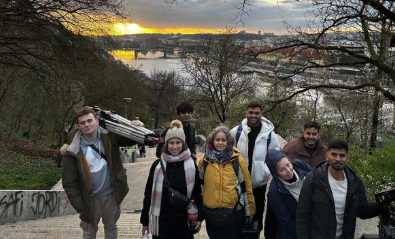
Photo caption: front row, left to right: Faris Sabanija (Assistant Director), Olivia Dance (Script Supervisor), Jasmine Huggins in yellow, Matilda Linde (First Assistant Camera); Aditya Verma (Gaffer)
back row, left to right: Karan Parekh (Best Boy), Parth Vikamsey (Director of Photography), Tony Dhull (2nd AC),